

Understanding Cross-Docking
Cross-docking is a logistics strategy that seeks to optimize the supply chain by minimizing the time products stay in storage. Instead of storing products for long periods, cross-docking involves receiving products, sorting them quickly, and shipping them directly to their final destination. It works like a distribution center where products simply move from one truck to another without going through long-term storage.
How does it work?
- Receiving: Products arrive at the cross-docking center in large volumes.
- Sorting: Products are sorted and grouped according to their final destination.
- Consolidation: Products are consolidated into larger shipments to optimize transportation.
- Dispatch: Products are loaded directly onto outbound vehicles heading to their destinations.
Benefits of cross-docking
- Lower costs: By minimizing storage, the costs associated with it are reduced, such as space rental, labor, and insurance.
- Greater efficiency: Products move faster through the supply chain, improving operational efficiency.
- Lower inventory: By keeping less inventory, storage costs are reduced and the risk of obsolescence is minimized.
- Higher customer satisfaction: Orders can be delivered faster, increasing customer satisfaction.
Is cross-docking right for my company?
Cross-docking is not suitable for every company. To be effective, certain conditions are required:
- High product volume: Cross-docking is most efficient when handling large volumes of products.
- High-turnover products: Products that sell quickly are ideal for cross-docking.
- Demand predictability: Good demand forecasting is needed to plan shipments effectively.
- Efficient transport network: A well-established transport network is crucial for cross-docking success.
- Robust information systems: Advanced warehouse and transport management systems are required to manage product flow.
Organize your loading and unloading area to work faster
Organize the space:
- Divide the area: Separate the space into clear zones: one for receiving goods, another for preparing shipments, and another for loading trucks.
- Minimize space: Avoid leaving too much empty space between products. The less space there is, the faster things move.
- Distribute the weight: Place packages so the truck is not unbalanced.
- Keep everything visible: Make sure all packages are in sight so no time is lost looking for them.
Organize the work:
- Clear schedules: Have a fixed schedule for receiving and shipping goods.
- One single movement: Try to ensure each package is moved as little as possible.
- Prioritize: Sometimes it's better to wait a bit and load a truck directly, rather than unloading everything quickly.
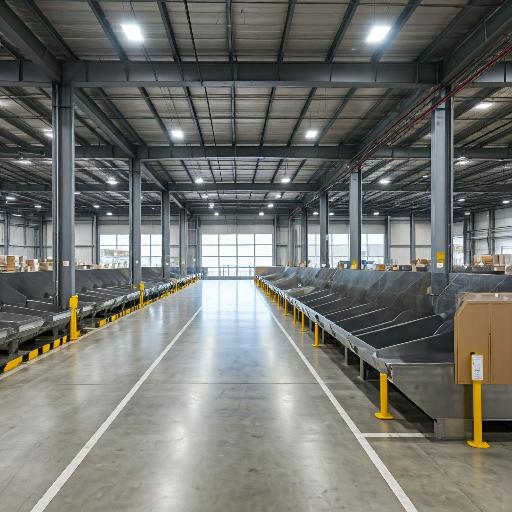
- Use tools: Conveyor belts can help you move things faster.
In summary:
Order and cleanliness: An organized space makes you work faster and prevents errors.
Planning: Organize your work in advance to avoid delays.
Tools: Use tools that help you move things efficiently.
How do I implement cross-docking in my company?
Implementing a cross-docking system may seem complex, but with proper planning and the right tools, it is entirely achievable. Here are some key steps:
1. Assessing the current situation:
- Supply chain analysis: Identify weak points and opportunities for improvement in your current logistics process.
- Product volume: Assess whether your product volume is sufficient to justify investing in a cross-docking system.
- Demand predictability: Accurate demand forecasting is essential for planning cross-docking operations.
2. Warehouse layout design:
- Well-defined zones: Create specific areas for receiving, sorting, consolidation, and dispatch.
- Efficient flow: Design a workflow that minimizes movement and waiting times.
- Flexibility: Consider an adaptable design for future expansions or changes in product volumes.
3. Technology selection:
- Warehouse management system (WMS): Implement software that lets you efficiently manage all warehouse operations, from receiving goods to dispatch.
- Material handling equipment: Invest in quality equipment, such as forklifts and conveyors, to optimize processes.
- Automatic identification systems (RFID): Consider using RFID to track products throughout the entire supply chain.
4. Staff training:
- Specific training: Provide training courses to your employees so they learn the new processes and procedures.
- Clear communication: Make sure all employees understand the importance of cross-docking and their role in the company's success.
5. Gradual implementation:
- Pilot: Start by implementing cross-docking in a small part of your warehouse to evaluate results and make adjustments if necessary.
- Continuous monitoring: Track key performance indicators (KPIs) constantly to measure system efficiency and detect areas for improvement.
Benefits of cross-docking:
- Lower costs: Less storage time, less labor, and optimized transport.
- Greater efficiency: Faster and more accurate flow of goods.
- Better customer service: Faster and more reliable deliveries.
- Lower inventory: Reduced storage and obsolescence costs.
Want help implementing cross-docking in your company?
Hire us here: Sales WhatsApp +51 946377197
email: leads@ganemo.co
Odoo WMS: The ideal solution to optimize your cross-docking management
Managing cross-docking demands efficiency, precision, and full visibility across the supply chain. Odoo ERP, with its robust features, is an indispensable tool for optimizing your cross-docking operations and reaching new levels of productivity.
Why is Odoo ERP the perfect choice for your cross-docking?
Odoo offers a complete set of tools designed specifically to manage product flows efficiently in a cross-docking environment.
Some of its most notable features include:
- Cross-docking routes: Define specific routes for products that must be shipped directly to the customer without going through storage.
- Location management: Organize your warehouses and cross-docking areas efficiently, optimizing workflows.
- Optimized picking and packing: Create customized picking and packing orders for cross-docking, ensuring high accuracy and speed.
- Carrier integration: Connect your system with different carriers to manage deliveries simply and efficiently.
- Real-time visibility: Get a complete view of the status of your shipments at all times, from receipt to delivery.
- Customization: Adapt Odoo ERP to your business's specific needs and the requirements of your cross-docking process.
Benefits of using Odoo ERP for your cross-docking
- Greater efficiency: Reduce processing times and minimize errors.
- Better accuracy: Ensure shipment accuracy and reduce returns.
- Greater visibility: Get a complete view of your supply chain.
- Lower costs: Optimize resource use and reduce operating costs.
- Scalability: Adapt your system as your business grows.
A practical example: Managing a distribution center with Odoo
Imagine a distribution center that receives products from different suppliers and ships them immediately to customers. With Odoo ERP, you can:
Set up cross-docking routes: Define specific routes for products that do not require storage.
Create picking and packing orders: Generate optimized picking orders for cross-docking, indicating which products should be grouped and shipped together.
Assign tasks to workers: Assign picking and packing tasks to workers efficiently.
Generate shipping labels: Create customized shipping labels for each order.
Track shipments: Follow shipments in real time and notify customers about the status of their orders.
Want to discover how Odoo can transform your cross-docking management?
Hire us here: Sales WhatsApp +51 946377197
email: leads@ganemo.co